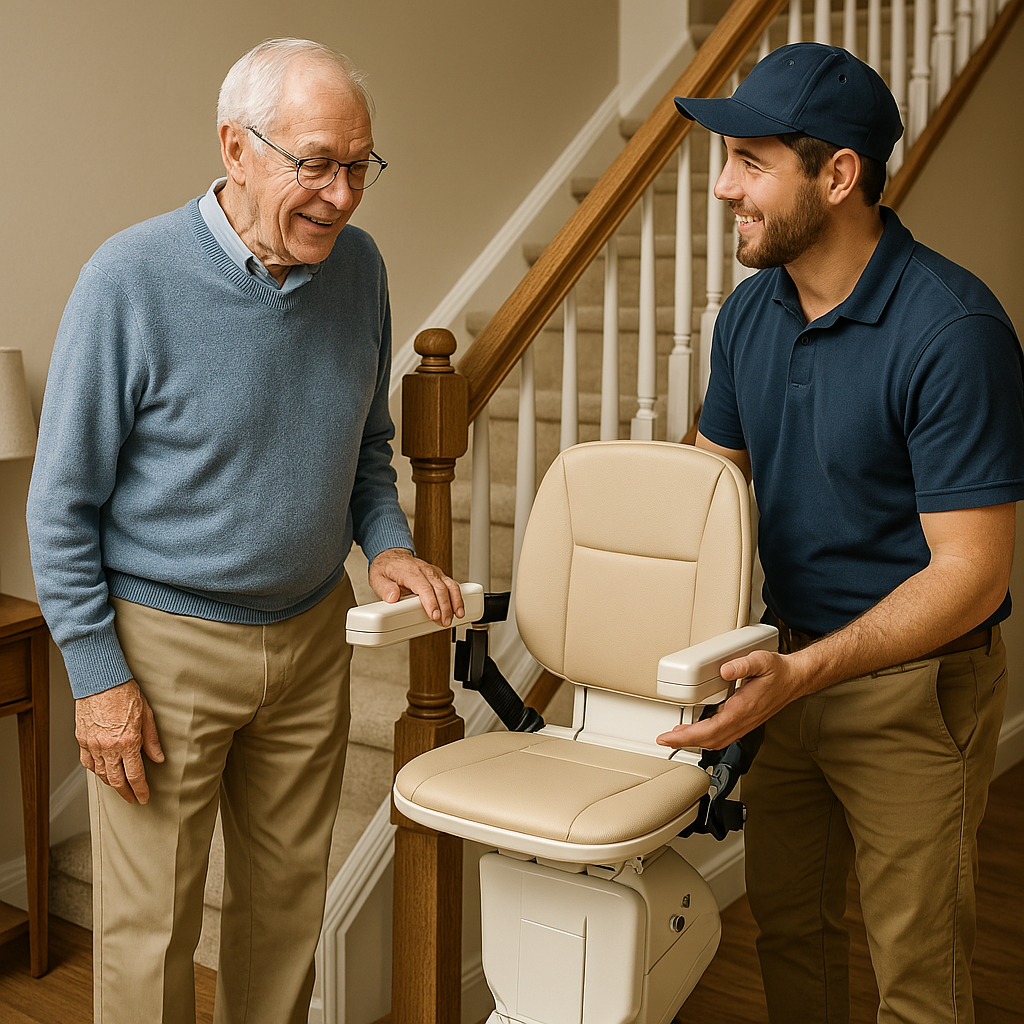
A staircase lift offers a practical solution for many people as they age or develop mobility issues that could make navigating stairs challenging. It allows seniors and individuals with limited mobility that normally require walking aids, to maintain their independence at home.
Stairs are one of the most common locations for serious falls, making them a key focus in improving overall bathroom safety for seniors and fall prevention throughout the home.
As more seniors choose to age in place, the stair lift has become a reliable home modification that addresses safety concerns and quality of life.
This comprehensive guide will explore everything you need to know about the different types and features as well as installation considerations and maintenance requirements.
What Is a Staircase Lift?
A staircase lift is a motorized chair that travels along a rail system. That rail is mounted to the staircase treads and follows the contours of your staircase.
The user sits securely in the chair and controls its movement up or down the stairs with simple button controls or a joystick. This eliminates the need to physically climb stairs, which can be painful, even dangerous for those with mobility limitations.
For adult children helping their aging parents stay safe at home, a staircase lift can offer both peace of mind and daily reassurance—knowing your loved one can safely navigate their multi-level home without risk of dangerous falls.
These systems are designed to be unobtrusive when not in use, with many models featuring foldable components that minimize obstruction on the stairway for other household members.
Staircase Lift Types
Straight Staircase Lift: Simple and Affordable
Straight staircase lifts are designed for staircases that go directly from one floor to another without curves, bends, or landings in between.
These represent the most straightforward and economical option for many homes. The installation process is relatively quick and simple, as the rail mounts directly onto the stair treads rather than the wall.
Many seniors and their families choose straight staircase lifts because they:
- Cost less than curved models
- Can often be installed within a day
- Require minimal customization
- May be available as refurbished units to reduce costs
For seniors with standard staircases, straight lifts offer an affordable way to maintain independence and move safely between floors.
Curved Staircase Lift: for Complex Layouts
Homes with more elaborate staircases require specialized solutions.
Curved stair lifts are custom-built to fit staircases with bends, turns, or intermediate landings. The manufacturing process involves precise measurements and customization to ensure the rail follows your staircase’s exact configuration.
While more expensive than straight models, curved staircase lifts offer:
- Seamless navigation around corners and bends
- Custom fit for unique staircase designs
- Ability to traverse multiple levels with a single unit
- The same safety features as straight models
For seniors living in older or custom-built homes with architectural staircase features, these lifts provide access to all areas of their home without compromise.
Not sure whether your staircase requires a straight or curved lift? This comparison highlights the key differences in installation, customization, and cost so you can better understand which option fits your home.
Straight Staircase vs. Curved Staircase
| Feature | Straight Staircase Lift | Curved Staircase Lift |
|---|---|---|
| Staircase Type | Straight with no landings | Curved, spiral, or multi-landing |
| Installation Time | 1 Day | Several Weeks |
| Customization | Minimal | Fully Custom-Built Rail |
| Cost | Lower | Higher |
| Transferability | Can be reused in other homes | Custom fit, not easily transferable |
Understanding these differences can help you choose the right type of staircase lift for both your home’s layout and your long-term mobility needs.
Weather-Resistant Outdoor Staircase Lift
Many seniors face mobility challenges not just inside their homes but also when accessing entryways, decks, or garden areas. Outdoor staircase lifts are specifically engineered to withstand environmental challenges while providing the same convenience as indoor models.
These specialized lifts feature:
- Weather-resistant materials and components
- Protective covers to shield mechanics from rain, snow, and debris
- Durable finishes that resist corrosion and UV damage
- Enhanced drainage systems to prevent water accumulation
For elderly individuals who enjoy spending time in their gardens or need to navigate exterior steps to enter their homes, outdoor stair lifts extend independence beyond interior spaces.
Space-Saving Designs for Narrow Staircases
Many older homes feature narrow staircases, which present unique challenges when installing a stair lift. Manufacturers have developed innovative space-saving models specifically for these situations, with features designed to minimize obstruction.
Space-saving staircase lifts typically include:
- Foldable seats that tuck away when not in use
- Compact footrests that fold up automatically
- Slim-profile rails that maximize clearance
- Optional powered folding mechanisms for users with dexterity issues
These thoughtful designs ensure that even in homes with limited stairway width, seniors can enjoy the benefits of a staircase lift without creating hazards for other household members.
Essential Features and Buying Considerations
Weight Capacity for Safe Operation
When selecting a staircase lift, weight capacity is a critical consideration. Standard models typically support between 250 to 350 pounds, which accommodates most users. However, for individuals requiring additional support, heavy-duty options can handle up to 600 pounds.
Ensuring your staircase lift has the appropriate weight capacity is essential for:
- Safe daily operation
- Long-term durability of the equipment
- Prevention of premature mechanical wear
- Peace of mind for both users and family members
Always include a comfortable margin when calculating weight capacity needs, accounting for clothing, items being carried, and possible future changes in the user’s weight.
Safety Features That Protect Vulnerable Users
Staircase lifts incorporate a number of safety features designed specifically with elderly users in mind leading many homeowners to include staircase lifts as part of a broader aging in place remodeling plan.
Essential safety components include:
- Secure seatbelts or harnesses that prevent falls during operation
- Swivel seats that rotate at the top or bottom of stairs for safe transfers
- Sensitive obstruction sensors that detect objects on the stairs and stop the lift
- Easily accessible emergency stop buttons for immediate halting
- Reliable battery backup systems that function during power outages
For adult children arranging home modifications for aging parents, these safety features provide reassurance that your loved one can navigate stairs without supervision.
Track Installation and Home Compatibility
Understanding how staircase lift tracks mount to your stairs can ease concerns about potential damage to your home. Most tracks mount directly to stair treads—not walls—so installation won’t damage your home’s structure or aesthetics.
Important track considerations include:
- Minimal impact on your home’s structure
- Custom fabrication requirements for curved staircases
- Potential for modifications to accommodate landings
- Options for extending or shortening tracks as needs change
For seniors planning to age in place, selecting a system with appropriate track design ensures long-term usability with minimal disruption to the home.
User-Friendly Control Options
Staircase lifts feature intuitive controls designed for users with varying degrees of dexterity and cognitive abilities. These control systems make operation straightforward even for seniors with arthritis or limited hand strength.
Common control options include:
- Remote controls that allow sending the lift to another floor
- Wall-mounted call stations for summoning the lift when needed
- Simple joystick or push-button controls on the chair armrest
- Optional footrest controls for users with limited hand mobility
Family members should consider which control system best matches their elderly loved one’s abilities and preferences to ensure comfortable, confident use.
Reliable Power Supply Solutions
Most staircase lifts operate on household electricity, operating on efficient motors that minimize energy consumption. However, power continuity is essential for seniors relying on these devices for mobility.
Modern staircase lifts address power concerns through:
- Low-voltage systems that reduce energy costs
- Continuous charging while the chair is docked
- Battery backup that maintains functionality during outages
- Energy-efficient components that extend battery life
For elderly individuals in areas prone to weather-related power interruptions, these features ensure continued access to all areas of their home regardless of external conditions.
Installation Timeline and Space Requirements
The installation timeline for a staircase lift can vary depending on the unique characteristics of your staircase. Straight models can typically be installed within hours, providing quick solutions for seniors with immediate mobility needs.
Curved models require a more involved process, often taking several weeks from measurement to final installation due to custom fabrication requirements.
Proper installation requires:
- Adequate landing space at both the top and bottom of stairs for safe transfers
- Sufficient stairway width to accommodate both the lift and foot traffic
- Consideration of doorways or hallways that might be affected
- Potential folding rail extensions to prevent obstruction at entrances
Professional installation ensures your staircase lift functions safely and reliably, giving elderly users and their families confidence in the system’s operation.
“Looking after wear-and-tear issues is important, but preventive maintenance matters even more. Some parts naturally wear down or require lubrication over time. Most companies offer scheduled service check-ups—and they know their equipment better than anyone. Take advantage of that expertise!”
Maintaining Your Staircase Lift
Like any mechanical system, staircase lifts require regular maintenance to ensure continued safe operation.
Establishing a routine maintenance schedule extends the lifespan of your investment and prevents unexpected breakdowns that could impact your loved one’s mobility.
Essential maintenance practices include:
- Regular inspections to check for wear on tracks and mechanical components
- Timely battery replacements to maintain reliable operation
- Routine cleaning and lubrication of tracks for smooth, quiet travel
- Periodic professional servicing to address potential issues before they become problems
Many manufacturers offer maintenance plans specifically designed for seniors.
Benefits of a Staircase Lift for Elderly Residents
Enhanced Independence for Aging in Place
Perhaps the most significant benefit of a lift system is how it supports independent living for seniors. Installing a staircase lift is one of several home modifications for seniors designed to reduce fall risk.
By removing the necessity of climbing stairs, these systems allow elderly individuals to remain in their own homes rather than relocating to single-level housing or assisted living facilities.
The ability to move freely between floors means:
- Continued access to all areas of a familiar home
- Maintenance of established routines and lifestyle
- Preservation of community connections and neighborhood relationships
- Extended time living independently before more intensive care may be needed
For many seniors, this independence directly contributes to better mental health and quality of life as they age.
Reduced Fall Risk and Injury Prevention
Stair-related falls represent one of the most serious hazards for elderly individuals, often resulting in severe injuries and loss of independence. Installing a stair lift directly addresses this risk by eliminating the need to climb stairs.
The safety benefits include:
- Prevention of stair-related falls that can lead to broken bones
- Reduced strain on joints and muscles already affected by arthritis or other conditions
- Decreased risk of fatigue-related accidents
- Improved overall home safety profile
Adult children often find that investing in a staircase lift provides immeasurable peace of mind—knowing their parents are at significantly lower risk for one of the most common and dangerous household accidents.
Peace of Mind for Users and Caregivers
The psychological benefits of staircase lifts extend beyond the user to include family members and caregivers. Knowing that an elderly loved one can safely navigate their home reduces worry and stress for everyone involved.
This peace of mind allows:
- Reduced anxiety about daily activities
- Less frequent check-in visits specifically for stair assistance
- Decreased worry about unsupervised stair use
- More focus on enjoyable family interactions rather than caregiving duties
“Installing a staircase lift gave us peace of mind. For the first time in years, we didn’t have to worry about our elderly parents using the stairs alone.”
I’ve heard adult children say that installing a staircase lift has significantly reduced their stress levels regarding their parents’ safety at home.
Cost-Effective Alternative to Major Life Changes
“Some adult children are uncomfortable discussing their parent’s safety in terms of cost—that’s understandable. But I always remind them that by being financially prudent they are guaranteeing long term autonomy and dignity, for their parents and loved ones.”
When comparing the cost of a staircase lift to other options like moving to a single-story home or extensive home renovations, many families find it represents a practical financial decision.
The economic advantages include:
- Lower investment than relocating to a new home
- Avoidance of real estate fees and moving expenses
- No need for costly structural modifications to create first-floor bedrooms
- Potential increase in home value through accessibility improvements
For seniors on fixed incomes, staircase lifts offer an affordable solution that preserves both financial resources and quality of life.
So what does installing a staircase lift typically cost? The table below outlines common price ranges for both straight and curved lifts, including installation and optional upgrades.
Staircase Lift Cost Comparison
| Item | Straight Lift | Curved Lift |
|---|---|---|
| Base Unit | $2,000 – $5,000 | $9,000 – $15,000 |
| Installation | $500 – $1,500 | $1,500 – $3,000 |
| Optional Features | $300 – $1,000 | $500 – $2,000 |
| Total Estimate | $2,800 – $7,500+ | $11,000 – $20,000+ |
While exact costs vary by home layout, features, and installer, these ranges give a realistic starting point for planning a staircase lift investment.
An Investment In Autonomy
A stair lift represents more than just a mobility aid—it’s an investment in safety, independence, and quality of life for seniors aging in place.
By understanding the various types available, key features to consider, installation requirements, and maintenance needs, families can make informed decisions that support their loved ones’ desire to remain in their homes safely and comfortably.
Final Thoughts
For adult children helping aging parents navigate mobility challenges, a staircase lift offers a practical solution that addresses immediate safety concerns while respecting their parents’ wish for continued independence.
As our population ages, these thoughtful home modifications become increasingly important tools for maintaining dignity and autonomy throughout the later years of life.
When considering home accessibility improvements for elderly family members, a staircase lift deserves serious consideration as a reliable, effective solution that can transform a challenging multi-level home into a safe, low-challenge environment for years to come.
Want to keep exploring? Here are some related articles: