Every day, millions of older adults face one of the most dangerous moments in their home—sitting down on the toilet and standing back up again.
It sounds simple. But for seniors and anyone dealing with balance issues, weak knees, or reduced strength, that movement is one of the highest fall-risk activities in the entire house.
Here’s the good news. Grab bars for toilet areas are effective, affordable, and one of the most important upgrades in overall bathroom safety for seniors.
In this article, I’ll walk you through everything you need to know—from why the toilet area is so risky, to which type of grab bar is right for your situation, to how to get it installed correctly and safely.
Why the Toilet Area Is a High Fall-Risk Zone
The bathroom, while typically the smallest room in a house, can also hold some of the greatest concerns for elderly adults. And the toilet area presents unique challenges. Here’s why:
- Sitting and standing can be challenging for anyone with arthritis, balance issues or general weakness.
- There’s little room to recover if you lose your balance in a narrow bathroom.
- The environment can be wet and slippery.
- Night-time fatigue and low lighting are a dangerous combination.
The right toilet safety rail or grab bar changes all of this. It gives you something solid to push against, lean into, or hold as you move. That one anchor point can make all the difference.
Types of Grab Bars for Toilet Support
Not all grab bars are the same. There are several types, and each one fits a different situation. Let’s look at the main options.
Wall-Mounted Grab Bars
Wall-mounted grab bars are the benchmark when it comes to toilet support. They are fixed directly into the wall and, when properly installed, they are incredibly strong and reliable.
- A properly anchored wall bar can support several hundred pounds
- They’re ideal if you’re aging in place and want a permanent solution
- They don’t take up floor space or interfere with the toilet itself
- For maximum strength they must be anchored into the wall stud
Wall-mounted grab bars are the best choice for homeowners who are committed to making their bathroom safe for the long term. If you’re setting up the bathroom for an aging parent, this is often the option I recommend first.
Fold-Down Grab Bars
Fold-down grab bars attach to the wall but can swing up and out of the way when not in use. This makes them a smart option for shared bathrooms.
- Space-efficient—fold flat against the wall when not needed
- Great for shared bathrooms—other family members won’t be inconvenienced
- Still wall-mounted—so they offer solid, reliable support when in position
- Slightly more involved installation—but still a durable, long-term solution
For seniors who share a bathroom with a spouse, or live in a multi-generational home, fold-down bars offer the best of both worlds—safety when needed and open space the rest of the time.
Toilet Frame and Toilet Rails for Safety
Toilet safety rails—also called toilet rails, toilet bars, or toilet frames—are freestanding or bolt directly onto the toilet itself. They don’t require any drilling into the wall, making them a great choice for those recovering from surgery, or in assisted living.
- No wall mounting required and they install with just a basic wrench
- Portable and adjustable, making them great for renters
- Provides handles on both sides of the toilet for balanced support
- Lower weight capacity than wall-mounted bars, so check the rating carefully
Toilet rails are a popular choice for a quick safety solution without making permanent changes. They’re also a good first step when you’re just beginning to assess bathroom safety needs.
Not sure which type of grab bar or toilet support is the best fit for your bathroom? This quick comparison makes it easier to see how wall-mounted bars, fold-down bars, and toilet frames differ in terms of installation, stability, and everyday use.
Quick Comparison: Toilet Grab Bar Options
| Type | Installation | Best For | Stability |
|---|---|---|---|
| Wall-Mounted Bar | Drilled into studs | Permanent safety | Very High |
| Fold-Down Bar | Wall-mounted | Shared bathrooms | High |
| Toilet Frame / Rails | No drilling | Temporary / renters | Moderate |
As you can see, each option has its place. The best choice comes down to how permanent the solution needs to be, how much support is required, and how your bathroom is laid out.
How to Choose the Right Option
Choosing the right grab bar for your toilet area comes down to a few key factors. Here’s how to think it through.
Stability vs. Flexibility
Consider your options. First, be clear about your actual needs. Is this a permanent setup, or does it need to be temporary or portable?
Permanent solutions
- Wall-mounted bars offer the highest level of safety and support. They’re ideal for homeowners aging in place.
Temporary solutions
- Toilet safety rails, and freestanding frames are better for renters, those recovering from a short-term injury, or situations where the bathroom setup might change.
As a general rule, permanent is better for long-term safety. But a good toilet rail is far better than no support at all.
Weight Capacity
This matters more than most people realize. Always check the weight rating before purchasing any grab bar or toilet safety rail.
- Look for a minimum rating of 250—300 lbs.
- In a real fall or stumble (dynamic) force is applied—far more than a person’s resting (static) weight
- A bar rated for 200 lbs. may hold up under normal use but fail at the worst possible moment
Don’t cut corners here. Choose a bar with a higher weight rating than you think you need.
Bathroom Layout Considerations
The physical layout of your bathroom will play a big role in which option will work best for you. Consider:
- Wall spacing on either side of the toilet: Is there a stud within reach for wall mounting?
- Toilet placement: Is it in a corner, against a wall, or freestanding?
- Clearance for mobility aids: Frame-style toilet rails can block access for rollators and walkers.
Ideally, have a contractor or occupational therapist assess the space to save time, money, and frustration—especially if mobility aids like a rollator or walker are already being used.
User Needs
The right type of support bar also depends on the specific person using it. Think about:
- Arthritis: Look for bars with larger diameter grips and textured, non-slip surfaces
- Balance issues: Bilateral support (bars on both sides) may be more helpful than a single bar
- Post-surgery recovery: A toilet safety rail frame is often the best short-term solution after hip or knee replacement, since it provides support on both sides and doesn’t require installation
When in doubt, talk to a physical therapist or occupational therapist. They can make a specific recommendation based on the user’s strength, mobility, and bathroom setup.
Proper Placement for Maximum Safety
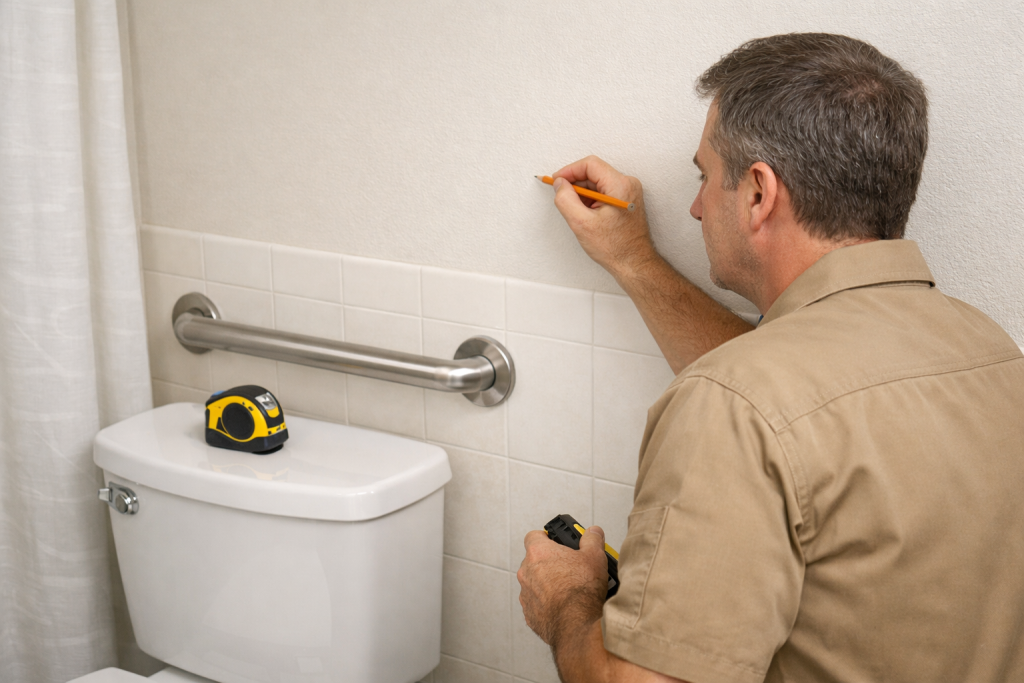
“Before drilling into a tile wall, consider any future upgrades you might be considering for the bathroom—especially a comfort height or raised toilet. The difference in tank heights would affect the grab bar placement and installation.”
Getting the placement right is just as important as choosing the right bar.
Grab bars placed in the wrong location or not anchored properly provide a false sense of security.
Here are some key guidelines to follow:
Side wall placement:
- The most common and effective location is on the wall beside the toilet
- Position the bar so it runs parallel to the floor, or at a slight upward angle
- The bar should be within easy reach while seated, typically 6—8 inches to the side of the toilet centerline
Rear wall placement:
- A second bar on the rear wall (behind the toilet) can be added for additional support
- This is especially helpful when standing up from a fully seated position
- A rear bar is typically mounted 6 inches above the tank height
Height range guidance:
- Most grab bars beside the toilet are installed 33—36 inches from the floor
- This height aligns with where the hand naturally falls when pushing up from a seated position
Distance from toilet:
- The bar should be within 12 inches of the front of the toilet seat so it’s easy to reach while seated
“Another common mistake I see—and have lived through—is waiting too long to install grab bars. In my case we did not see my parent as ‘old.’ It was a mistake to wait and one I’ll regret for the rest of my days. This is one of the simplest and most effective upgrades you can make in a single day.”
Common Mistakes to Avoid
- Placed too far forward. It needs to be within easy reach from a seated position.
- Not anchored into studs. Always anchor into wall studs or use a proper blocking panel.
- Relying on suction-cup bars. Suction grab bars seem convenient but can release without warning.
Installation Tips and Safety Warnings
This is where mistakes can have dangerous consequences. For an even more detailed breakdown, see this guide to grab bars for seniors.
Anchor Directly into Wall Studs
This is non-negotiable. Wall studs are the structural backbone of your wall. A grab bar attached only to drywall has almost no holding strength.
Why Suction Cups Fail
Suction cups rely on an airtight seal. Bathroom humidity, tile texture, grout lines, and normal wear all compromise that seal.
In a real fall, the force applied to the bar is sudden and strong—far beyond what a suction attachment can handle.
When to hire a contractor
I recommend hiring a professional installer—especially if you’re not confident about working with tile walls.
Paying $100—$250 for labor, is a small price compared to the cost of a fall. Your community might also offer subsidized installation programs for seniors. Ask your local seniors’ center or Area Agency on Aging.
Temporary vs. permanent solutions
Toilet safety rails and frame-style toilet bars are straight-forward and can typically be set up immediately and without tools. They’re a good bridge solution while you arrange for proper wall-mounted installation.
But treat them as temporary—not permanent replacements for properly anchored grab bars.
Comfort, Dignity, and Independence
For many seniors, the bathroom is the last place where they feel fully independent. It’s a private space, and needing help, fearing a fall, can feel like a real loss.
Installing grab bars for the toilet isn’t about giving up independence. It’s about protecting it.
When you feel independent, you feel more confident overall. You move better, you sleep better, you’re less anxious about daily routines. And here’s something that might surprise people—seniors who feel safe in their homes are actually more active.
Fear of falling leads to reduced movement—which ultimately leads to weaker muscles—which can lead to more falls. Good toilet safety rails can help to break that cycle.
For adult children, bringing up grab bars with a parent can be a sensitive conversation. Approach the topic as reinforcing confidence and independence and not fear or frailty.
Many seniors embrace the idea once they understand it’s about staying in control—not admitting a limitation.
When to Add Grab Bars for the Toilet
The best time to add grab bars for the toilet is before a fall happens. Here are some early signs that it’s time to act:
- Difficulty standing up from the toilet
- Using the sink, tank, or towel bar for support
- Hesitation at the toilet
- A recent fall or near-miss anywhere in the home
- A new diagnosis—arthritis, vertigo, Parkinson’s, a recent hip or knee surgery
You don’t have to wait for a crisis to act. Installing toilet rails or grab bars now is a proactive choice that can increase confidence, reduce anxiety, protect independence, and make your home safer for years to come.
How do you know when it’s time to add grab bars or toilet safety rails? In many cases, the warning signs show up before a fall happens, and recognizing them early can help prevent a much bigger problem later on.
Signs It’s Time to Add Toilet Grab Bars
| Sign | What It May Mean | Recommended Action |
|---|---|---|
| Difficulty standing up from the toilet | Leg strength, balance, or joint mobility may be declining | Install a grab bar or toilet frame before strain leads to a fall |
| Using the sink, tank, or towel bar for support | Existing fixtures are being used as substitutes for proper safety equipment | Add dedicated toilet grab bars with proper weight support |
| Hesitation or loss of confidence near the toilet | Fear of slipping or instability may already be affecting daily routines | Improve support early to restore confidence and reduce anxiety |
| Recent fall or near-fall in the bathroom | The bathroom is already becoming a high-risk environment | Act immediately with grab bars, rails, and a broader bathroom safety review |
| New diagnosis or recovery from surgery | Mobility, strength, or balance may be temporarily or permanently reduced | Use toilet rails or a toilet frame right away, then assess long-term needs |
The important thing is not to wait for a major fall before taking action. Small warning signs in the bathroom often point to a bigger safety issue developing, and toilet grab bars are one of the easiest ways to get ahead of it.
How Grab Bars Fit Into a Safer Bathroom Overall
Grab bars for the toilet are a great start—but true bathroom safety is about the whole environment. Here are a few additional areas to consider:
- Lighting: Install a motion-activated night light on the path from the bedroom to the bathroom.
- Bathing area: Consider a grab bar inside the shower, a fold-down shower bench, and a handheld showerhead for seated bathing.
Think of the bathroom as a layered safety system where each upgrade builds on the others. Together, they create a space where a senior can move confidently and stay safely at home longer.
Final Thoughts
Installing grab bars for the toilet is one of the most practical, high-impact things you can do to support safe aging at home. It’s not complicated. It’s not expensive. And it works.
If you’re a senior reading this, you deserve to feel steady and confident in your own home. Start with the toilet area. It’s the highest-risk spot and the easiest to fix. If you’re an adult child reading this, talk to your parent today.
Bring it up with care and focus on what these changes make possible—not what they signal. A simple toilet safety rail installed this weekend could prevent a serious injury next month.
Start simple—start now. The right grab bar in the right place can change everything.
Want to keep exploring? Here are some related articles: