
Traveling should be an enjoyable experience for everyone—including those who use a wheelchair. Whether that means a manual wheelchair, electric power wheelchair, or even a specialized wheelchair for travel.
Modern travel wheelchairs are designed to be lightweight and portable, making mobility much easier across airports, cruise ships, and city streets. They help seniors, people with disabilities, and caregivers navigate transportation with less stress.
This guide will help you understand what makes a good travel wheelchair and how to choose the best model for your specific needs.
Why Choose a Travel Wheelchair?
Standard wheelchairs often weigh 35-50 lbs.(16-22kg) and can be bulky to transport. A specialized travel wheelchair solves many of these problems. Here’s why you might want to consider one for your next trip:
Lightweight Design
Travel wheelchairs typically weigh between 15-30 lbs. (7-14kg). This lighter weight makes them much easier to lift into a car, carry up or down stairs, and handle during travel. Caregivers especially appreciate this feature when loading and unloading the chair multiple times during a trip.
Easy To Store
Most travel wheelchairs fold compactly, sometimes to the size of a large briefcase. Their foldable design means they take up minimal space in vehicles, hotel rooms, or cruise ship cabins. Some models can even fit in overhead airplane compartments or behind the front seat in a car.
“If you only travel occasionally, you might not need to buy a wheelchair at all. Many airports, senior centers, and even cruise lines offer rental or loaner chairs. Check with your travel provider or local aging-in-place support network before investing in your own.”
Travel-Friendly Features
Many travel wheelchairs meet airline requirements for carry-on or gate-check items. Their compact size works well in tight spaces like airplane aisles, busy restaurants, and crowded tourist attractions. Some models include travel bags for protection when not in use.
Greater Independence
Having a portable wheelchair means you don’t have to skip activities or destinations during your travels. Users gain more freedom to explore new places without worrying about mobility limitations. This independence makes vacations more enjoyable for both the wheelchair user and their traveling companions.
Key Features to Look for in a Travel Wheelchair
Not all travel wheelchairs are created equal. Here are the most important features to consider when shopping for one:
Weight & Portability
The weight of a travel wheelchair significantly impacts how easy it is to transport. Look for these weight categories:
- Ultra-lightweight Under 15 lbs. (7kg) Ideal for frequent travelers or those with limited strength
- Lightweight 15-20 lbs. (7-9kg) Good balance of durability and portability
- Standard travel 20-30 lbs. (9-13kg) More features and comfort, but still manageable for travel
Remember that the lighter the chair, the easier it will be to lift into vehicles or carry when needed. However, ultra-lightweight models might sacrifice some durability or comfort features to achieve their minimal weight.
Foldability & Compact Design
How a wheelchair folds matters almost as much as its weight. The best travel wheelchairs offer:
- Quick-folding mechanisms that don’t require tools or complicated steps
- Compact folded dimensions that fit easily in car trunks and storage spaces
- Self-locking features that keep the chair closed when folded
- Optional carry bags for protection during transport
Some newer designs fold like an umbrella, while others collapse flat. Consider which style would work best for your vehicle and storage needs.
Frame Material
The wheelchair’s frame material affects its weight, durability, and price:
- Aluminum: The most common choice, offering a good balance of strength and light weight
- Carbon fiber: Extremely lightweight but expensive
- Titanium: Very strong and lightweight but comes at a premium price
- Steel: Heavier but very durable and often found in less expensive models
For travel purposes, aluminum frames typically offer the best combination of reasonable weight and durability without breaking the bank.
Comfort & Cushioning
Even portable wheelchairs should provide reasonable comfort, especially for longer trips:
- Padded seats and backrests prevent discomfort during extended sitting
- Breathable materials help prevent overheating on warm days
- Tension-adjustable backrests conform to the user’s body shape
- Additional cushioning options can be added for users with specific needs
Remember that while thicker cushioning increases comfort, it may also add weight to the chair. Some travelers bring a separate cushion and use it only when needed for longer periods of sitting.
Wheel Type
“Some travel wheelchairs feature puncture-proof or solid tires that won’t go flat during your trip. This reliability factor is especially important when visiting places where wheelchair repairs might be difficult to find.”
The size and type of wheels affect how the wheelchair performs on different surfaces:
- Large rear wheels (20-24 inches): Better for outdoor use and self-propelling
- Medium wheels (12-16 inches): Good middle ground between maneuverability and stability
- Small wheels (6-8 inches): Best for indoor use and very tight spaces
For beach trips, consider a dedicated beach wheelchair with special all-terrain wheels.
Caregiver vs. Self-Propelled
Travel wheelchairs generally fall into two main categories:
Transport Chairs are designed to be pushed by a caregiver:
- Typically, lighter weight
- Have smaller wheels
- More compact when folded
- Usually less expensive
- Cannot be self-propelled by the user
Self-Propelled Travel Wheelchairs can be operated by the user:
- Feature large rear wheels with hand rims
- Allow independent mobility
- Usually slightly heavier than transport chairs
- Give the user more freedom
- Often include quick-release wheels for easier transport
Your choice depends on whether the wheelchair user can and wants to propel themselves—or if a caregiver will always be available to push.
Top Travel Wheelchairs
Here’s a closer look at some of the best options across different travel needs:
Best for Caregiver-Assisted Travel
Transport chairs excel when a caregiver will be pushing the wheelchair user. These models prioritize lightweight design and easy handling:
Features:
- Lightweight transport design, typically 14-19 lbs. (6-8kg) makes handling easy for caregivers
- Compact foldable frame that fits easily in car trunks and airplane overhead compartments
- Padded armrests & adjustable footrests for added comfort during longer trips
- Simple hand brakes allow caregivers to control the chair on slopes or inclines
- Swing-away footrests make transfers easier when getting in and out of the chair
Limitations:
- Not self-propelled – Requires a caregiver to push at all times
- Smaller wheels may struggle on rough outdoor surfaces
- Limited adjustability compared to standard wheelchairs
These chairs work best for travelers who always have a companion and primarily visit places with smooth surfaces like airports, shopping malls, and tourist attractions.
Best Budget-Friendly Travel Wheelchair
You don’t need to spend a fortune to get a reliable travel wheelchair. Budget-friendly options provide good basic features:
“Don’t assume you have to spend a fortune to travel well. Even a modestly priced transport chair can make a big difference if it’s the right fit for your needs. Look for smart features, not flashy extras.”
Features:
- Durable aluminum frame with hand brakes for caregiver control
- Weighs under 20 lbs. (9kg) for easy portability by most adults
- Folds flat for storage in tight spaces like small car trunks
- Basic padded seating provides reasonable comfort for shorter trips
- Affordable price point typically between $100-250
Limitations:
- Smaller wheels may not perform well on rough outdoor terrain
- Fewer comfort features than premium models
- Less adjustability in terms of seat height and position
- May not be as durable for very frequent travelers
These wheelchairs are perfect for occasional travelers on a budget or as a backup wheelchair for trips.
Best Self-Propelled Travel Wheelchair
Independent travelers often prefer self-propelled models that allow freedom of movement without always needing assistance:
Features:
- Weighs around 25 lbs.(11kg) balancing weight and durability
- Large rear wheels (20-24 inches) for both indoor & outdoor use
- Foldable with quick-release wheels for more compact storage
- Ergonomic seating design for better posture support during longer periods of use
- Adjustable axle positions for personalized propulsion efficiency
Limitations:
- Slightly heavier than transport-only models
- More expensive than basic transport chairs
- Takes up more space when folded than transport chairs
- Requires some upper body strength for self-propulsion
These wheelchairs work best for active travelers who want independence and plan to navigate various environments on their own.
Lightest Self-Propelled Travel Wheelchair
For those who need the lightest possible self-propelled option, ultra-lightweight models offer amazing portability:
Features:
- Super lightweight: Under 15 lbs. (7kg) for easy lifting and maneuverability
- Airline-approved size for carry-on travel or gate checking
- Compact folding mechanism for tight storage spaces
- Innovative materials like carbon fiber or aircraft-grade aluminum
- Minimal design that eliminates unnecessary weight
Limitations:
- Higher price point (often $700-2,000) compared to basic models
- May have weight capacity limitations: typically, 220-250 lbs. (100-113kg+)
- Fewer comfort features to maintain the ultralight weight
- Less durability for very rough handling
These chairs are ideal for frequent travelers who prioritize portability above all else and are willing to pay a premium for the lightest possible chair.
Best for Occasional Travel Use
Occasional travelers have different needs than daily wheelchair users. These chairs balance features with practicality:
Features:
- Folds compactly for car, cruise, and airplane travel
- Rear-wheel locks for added safety and stability
- Lightweight frame: Under 25 lbs. (11kg) for manageable transport
- Padded upholstery for basic comfort during shorter trips
- Good value for the features provided
Limitations:
- Not ideal for rough outdoor surfaces with smaller wheels
- May lack adjustability of higher-end models
- Less optimal for all-day use than specialized everyday wheelchairs
- Basic comfort features compared to premium options
These wheelchairs work well for vacation travel, visiting relatives, or occasional outings where a standard wheelchair would be too cumbersome.
Not sure where to start? Here’s a quick visual to help guide your choice:
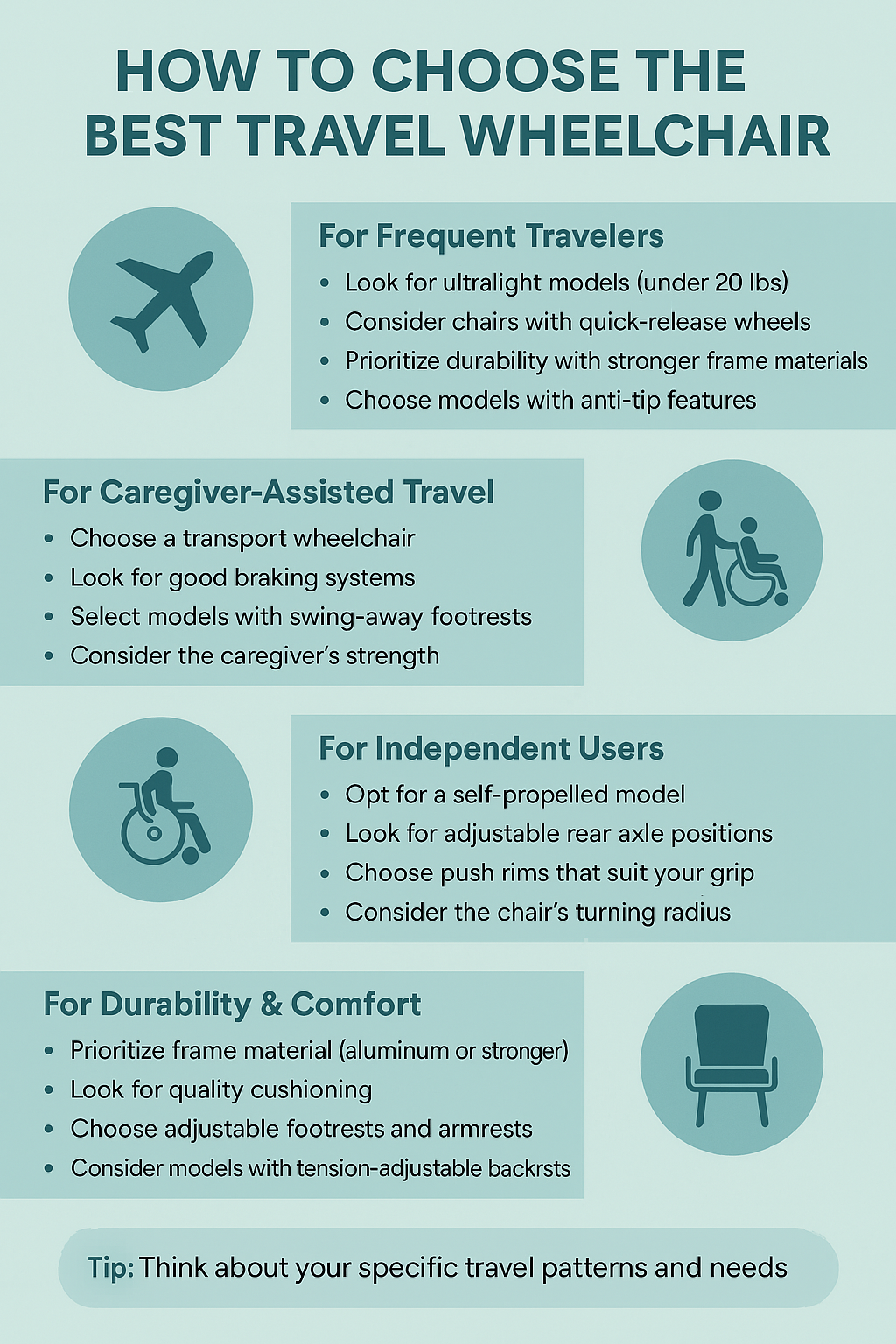
Courtesy of PetersHomeGuide.com – Helping you choose with confidence.
How to Choose the Best Travel Wheelchair for Your Needs
With so many options available, focus on your specific travel patterns and needs:
For Frequent Travelers
If you travel often, investing in higher quality makes sense:
- Look for ultralight models: Under 20 lbs. (9kg) with airline approval
- Consider chairs with quick-release wheels for more compact storage
- Prioritize durability with stronger frame materials
- Choose models with anti-tip features for safety in various environments
- Select chairs with good warranties since they’ll see more frequent use
For Caregiver-Assisted Travel
When someone will always be available to push:
- Choose a transport wheelchair with ergonomic handles to prevent caregiver strain
- Look for good braking systems for safety on inclines
- Select models with swing-away or removable footrests for easier transfers
- Consider the caregiver’s strength when choosing the chair’s weight
- Look for features that make folding and lifting easier
For Independent Users
Those who’ll propel themselves need different features:
- Opt for a self-propelled model with larger wheels for versatility
- Look for adjustable rear axle positions for efficient propelling
- Choose push rims that match your grip strength and preferences
- Consider the chair’s turning radius for navigating tight spaces
- Look for models with anti-tip wheels that can be adjusted for different terrain
For Durability & Comfort
If you’ll be spending many hours in the chair:
- Prioritize frame material (aluminum or stronger) for durability
- Look for quality cushioning that prevents pressure points
- Choose adjustable footrests and armrests for personalized positioning
- Consider models with tension-adjustable backrests for better posture support
- Look for wheels that perform well on the surfaces you’ll encounter most often
Budget Considerations
Travel wheelchairs range from under $200 to over $2,000:
Here’s a rough guide to what you can expect by budget tier:
- Basic transport chairs start around $100-250
- Mid-range self-propelled travel chairs cost $300-700
- Premium ultralight models can exceed $1,000
Remember that features like carbon fiber frames, larger wheels, and advanced folding mechanisms increase the price. Consider how frequently you’ll use the chair when deciding your budget.
Accessories That Enhance Travel Wheelchair Experience
“Travel accessories don’t have to be permanent add-ons. Think of them like travel gadgets—bring what you need for that specific trip and leave the rest behind.”
The right accessories can make your travel wheelchair even more useful:
- Travel bags protect your wheelchair during transport
- Cushions add comfort without permanently adding weight
- Cup holders keep drinks accessible on the go
- Phone/tablet mounts allow entertainment during longer waits
- Portable ramps help navigate small steps or thresholds
- Wheel covers keep car interiors clean when loading dirty wheels
- Backpack attachments provide convenient storage for personal items
Many of these accessories can be added or removed as needed, customizing the chair for each specific trip.
“Don’t let mobility challenges keep you grounded. Travel wheelchairs aren’t just about function—they’re about freedom. Choose what supports your life, your pace, and your adventures.”
Final Thoughts
The best travel wheelchair depends on your specific needs, budget, and travel style. Whether you need a compact transport chair for occasional trips or a self-propelled lightweight wheelchair for daily mobility, the right model can make traveling easier and more enjoyable.
When choosing a travel wheelchair, consider who will operate it, where you’ll be going, how often you’ll use it, and how it will be transported when not in use. These factors will guide you toward the model that offers the perfect balance of weight, features, and comfort for your unique situation.
With the right travel wheelchair, you can explore new destinations, visit loved ones, and participate in activities with greater ease and independence. Today’s innovative designs mean you no longer have to choose between portability and function—you can find a travel wheelchair that delivers both.